
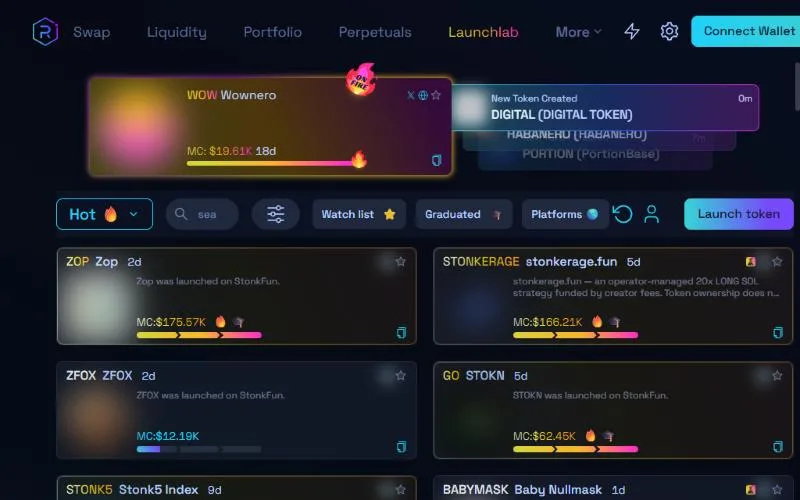
Raydium LaunchLab is Raydium's bonding-curve token launchpad: tokens trade on a curve and graduate to a Raydium CPMM pool once they raise a SOL target, with fees set by whichever platform runs the launch. It scores 6.8/10 in our launchpad method: the most configurable launch engine we list, with real usage through Bonk.fun and StonkFun, but fees that vary by front end and docs written mainly for developers.
Risk notice: Crypto trading is high risk and memecoins can go to zero in minutes. Trading bots and wallet connections use hot wallets. This page is not financial advice; only trade what you can afford to lose.
Facts on this page were checked October 23, 2026, from Raydium's own docs and the sources linked below. This is a research-based review built from published docs, not a hands-on trial.
LaunchLab at a glance
LaunchLab went live on April 16, 2025, a few weeks after Pump.fun stopped sending graduated tokens to Raydium and moved them to its own DEX, PumpSwap (crypto.news). Raydium delayed the release to line up support from trading partners such as BullX and Jupiter (Decrypt).
Per Raydium's docs, LaunchLab is two things:
- A launch page on raydium.io where anyone can create a token.
- An engine for other launchpads. Outside teams register a "Platform" and run their own branded launchpad on LaunchLab, choosing their own fees and post-graduation rules. Bonk.fun runs on it, and StonkFun moved new launches to it on September 6, 2026 (The Block).
That second role is why LaunchLab matters: when you buy a Bonk.fun token on its curve, you are trading on LaunchLab contracts.
JustSendit vs LaunchLab mode
Raydium's own launch page offers two creation modes (Raydium user guide):
| JustSendit | LaunchLab mode | |
|---|---|---|
| Setup time | About 1 minute | About 5 minutes |
| Supply | Fixed default | Configurable |
| Graduation target | 85 SOL, fixed | From 24 SOL, can be set higher |
| Share of supply on the curve | Default | 51% to 80% |
| Vesting | None | Optional (cliff plus linear unlock) |
| Creation cost | About 0.05-0.1 SOL | About 0.1-0.5 SOL incl. rent |
Both modes let you make an initial buy, and Raydium recommends one because sniper bots may otherwise take the earliest supply. Graduation is automatic: the trade that pushes the curve past its target triggers it, a CPMM pool is created with the raised SOL and remaining tokens, and the caller earns a small bounty. If a launch never graduates, Raydium does not step in.
Two vesting warnings from the same guide: any locked amount not assigned to a beneficiary before graduation is stuck permanently, and a beneficiary who loses their wallet key loses their tokens.
Fees: why there is no single number
LaunchLab fees stack, and the platform decides most of them. Raydium's fee reference lists, on the curve:
- Protocol fee: set by Raydium, not changeable by platforms (the docs' example rate is 0.25%).
- Platform fee: set by the launchpad running the token (example 1%).
- Creator fee: set by the platform (example 0.5%).
- Referral fee: optional, per transaction.
Under the August 17, 2026 upgrade, platform fees are capped at 1% and creator fees at 0.5%, according to Solana Compass. Raydium's developer reference still lists a higher maximum for the creator-fee field, so treat the cap as reported and check the actual rate on each launch. At launch in April 2025, crypto.news reported a 1% trading fee on Raydium's own page, with 25% of LaunchLab fees used to buy back RAY.
After graduation, the CPMM pool has its own trade fee (the docs' example is 0.25%, split 84% to LP, 12% protocol and 4% treasury) plus any creator fee the platform's pool config enables. Migration costs a 0.15 SOL pool creation fee.
The practical upshot: a Bonk.fun token and a token launched on raydium.io can have different fees even though both run on LaunchLab. For Bonk.fun's rates, see Bonk.fun vs Pump.fun.
The August 2026 upgrade: CPMM-only and platform-held LP
On August 17, 2026, Raydium changed two things for new launches and migrations (Solana Compass; Raydium creator fees):
- CPMM-only graduation. New launches must graduate to a CPMM pool; the older AMM v4 path is closed for them.
- LP goes to the platform. At migration, part of the LP is burned and the rest is locked in a Fee Key NFT. Before the upgrade, creators could get their own Fee Key; after it, the creator's share is merged into the platform's, and the Fee Key goes to the platform's wallet. Existing creator Fee Keys are unchanged.
For traders, locked or burned LP means the pool's liquidity can't be pulled. For creators, it means your post-graduation income now comes from the CPMM creator fee (if the platform enables it), not from LP fees.
How much is it used?
On DefiLlama, LaunchLab recorded about $6.4 million in 30-day fees and $246 million in 30-day volume as of October 23, 2026. Raydium's own revenue was about $1.2 million of that, because DefiLlama counts platform and creator fees as passed on to the launchpads. Monthly fees peaked at about $47 million in July 2025 during the Bonk.fun surge, fell below $1 million in late 2025, and jumped to about $10.7 million in September 2026 after StonkFun moved to LaunchLab.
Most of that activity comes through third-party front ends rather than raydium.io's own launch page.
LaunchLab vs other launchpads
| Launchpad | Engine | Curve fee | Graduation | After graduation |
|---|---|---|---|---|
| Raydium LaunchLab (raydium.io) | LaunchLab | Platform-set within caps | 85 SOL (JustSendit) or from 24 SOL | Raydium CPMM |
| Bonk.fun | LaunchLab | 0.30% reported (Classic) | Not published | Raydium CPMM |
| Pump.fun | Own | 1.25% | Curve completes | PumpSwap |
| Jupiter Studio | Own | 1% | 15,000 USDC raised | Meteora DAMM v2, locked |
More detail: Pump.fun review, Jupiter Studio review, and the full best Solana launchpad ranking.
Who should use LaunchLab
Good fit:
- Creators who want vesting, a custom curve allocation or a lower graduation target than 85 SOL.
- Teams building their own launchpad who want proven contracts.
Look elsewhere if:
- You want the most traders watching new launches. That is Pump.fun; see Pump.fun alternatives.
- You want one published fee you can quote. Pump.fun and Jupiter Studio both publish theirs.

Verdict
Raydium LaunchLab is less a single launchpad than the plumbing behind several of them. Its strengths are flexibility (two modes, vesting, configurable targets), real usage through Bonk.fun and StonkFun, and burned or locked LP after graduation. Its weaknesses are fees that change from one front end to the next, developer-first docs, and an August 2026 change that moved locked LP from creators to platforms. Check the actual fee and LP settings of any LaunchLab token before you trade it.


